CU Green Labs Program

The CU Green Labs Program uses a team approach to minimize the use of energy, water, and material goods in CU-Boulder’s laboratories without compromising research integrity or safety.  Click here to read more.


Scroll down to read about the great strides being made for conservation in CU-Boulder's Labs.

Buttons_r1_c3_s1

CU-Boulder Labs Win National Freezer Challenge Competition

university logos

CU-Boulder was one of the two top winners of the 2011 National Freezer Challenge. The challenge was made by University of California-Davis (UC-Davis), to universities across the nation to encourage labs to address the many actions that can be taken to improve sample access and energy efficiency related to lab freezers.  For more information on these actions, see the website that was created for CU-Boulder’s participation in the contest at https://sites.google.com/site/labfreezercompetitioncuboulder/

Forty-five CU-Boulder labs in total took actions that contributed to our total score in the competition. Funding to incentivize participation in the contest by CU-Boulder labs came from Sustainable CU, the Environmental Center, and Facilities Management Office of Sustainability.  However, many labs indicated that they participated simply because it was the right thing to do. In fact, the Anseth lab donated their UMC Connection gift card to Attention Homes in Boulder and the Blumenthal Lab asked that their winnings be used for additional conservation efforts in the MCDB Dept.

In the end, CU-Boulder was in competition against three other universities: UC-Davis, UC-Santa Barabara, and the University of Pennsylvania.   UC-Davis earned the most points with 951 points. CU-Boulder had the second highest point score with 504 points. Therefore, UC-Davis won the “most points” category. However, to normalize between campuses, the contest used the # of Ultra Low Temperature (ULT) freezers on each campus.   Davis has 923 ULT freezers (~1 point/ ULT) whereas CU-Boulder has 130 ULT freezers (~4 points/ULT). As a result, CU-Boulder overwhelming won the “normalized” category!!!

The following was accomplished during the Challenge at CU-Boulder:

  • 7 ULT freezer were raised in temp from -80˚C to -70˚C (or warmer) bringing our total of ULT freezers at -70˚C or warmer to 34 ULT freezers
  • 36 labs pledged to "Just Say Ultra Low" instead of "-80"
  • 10 new labs signed up for the CU Green Labs freezer maintenance program (to bring our total to 27 labs in the program)
  • 33.75 cubic feet of material was removed and properly discarded from ULTs
  • 74.6 cubic feet of material was removed and properly discarded from other freezer types and refrigerators
  • 44 units received preventative maintenance attention (defrosting, cleaning filters/coils)
  • 4 freezers and refrigerators were retired without replacement (consolidation)
  • 1 unit replaced with an Energy Star Unit
  • 3 freezers or refrigerators were unplugged
  • 5 labs tested out room temperature storage of DNA and/or RNA
  • 56 units were inventoried/reorganized

Way to go CU-Boulder Labs!!! These are impressive results!


Bierbaum Lab Puts 5 Diffusion Pumps on Timers & Saves 58,000 kWh/yr plus 1 million gallons/yr of water

bierbaum_lab_lower_resolutionWhen CU Green Labs asked about putting diffusion pumps on timers and no one thought it was possible, Veronica Bierbaum and the Bierbaum Lab from the Department of Chemistry and Biochemistry stepped up to the plate to give it a try.  Diffusion pumps, which are used to reach high vacuum conditions, are very large consumers of both electricity and water.  The Bierbaum Lab dampers off its 11 diffusion pumps from its vacuum chambers at the end of each day because, unlike other diffusion pump users, they do not need the pumps overnight.  Manually shutting down the diffusion pumps at night, however, was not a possibility for the lab because of the long cool-down and warm-up periods.  This project idea was passed on from CU Green Labs to Facilities Management Engineers for analysis and implementation.  CU Facilities Management Office of Resource Conservation has now paid for and completed the installation of timers for five Bierbaum diffusion pumps1 which are estimated to be saving an combined 58,0000 kWh/yr in electricity (the equivalent of electricity use by over 5 average US houses) plus 1 million gallons of water per year.  And there are plans to put the remaining 6 diffusion pumps on timers in the near future.   If you have diffusion pumps at CU-Boulder which you would like to have on timers for energy and water savings, please contact Kathy at This e-mail address is being protected from spambots. You need JavaScript enabled to view it .

1. Three 10 inch diffusion pumps  (pulls 2.25 kW each constantly when on) and two 6 inch diffusion pumps (pulls 1.35 kW each constantly when on) uses a combined total of 9.45 kWh and approximately 180 gallons of water every hour.


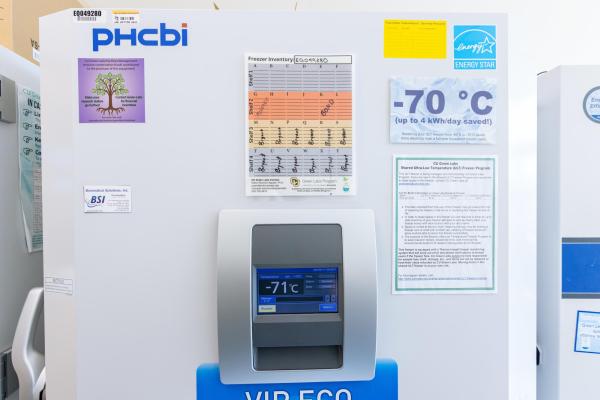
Ultra Low Temperature Freezers Raised to -70˚C from -80˚C for large energy savings (2-4 kWh/day) 

-80_freezer

CU-Boulder Labs with ULT freezers at -70˚C or warmer

Anseth
Blumenthal
Chen/Junge
Collins/Stitzel
Copley
Ehringer/Marks
Garcea
Han
Martin
Moore
Poyton
Seals
Schmidt
Shen
Smolen
Stein
Taatjes
Winey
Xue

On University campuses across the nation, freezers are collectively massive consumer of energy and growing in numbers especially in biological studies and medical labs.  Ultra Low Temperature (ULT) freezers are particularly large consumers, each using approximately the same electricity as an entire average US house (ULTs typically consume 15-30 kWh/day) plus the energy consumed to remove the large amount of heat rejected by these freezers into the laboratory space.

Janet Fox from the Winey Lab in MCDB first presented the idea to CU Green Labs of raising the temperature of ULT freezers from -80˚C to -70˚C (let’s face it, both temperatures are still really cold), an idea that was already being pursued by the University of California at Davis (UC-Davis).  According to measurements made at the UC-Davis, raising the temp on ULT freezers from -80˚C to -70˚C not only reduces electricity use on average by 2kWh/day (nearly a 10% drop), but also frequently results in a longer freezer lifetime due to decreased work by the unit compressor.  Manufacturers have reported even larger savings of~4 kWh/day for this action.

At CU-Boulder, ~30%of all ULT freezers are at -70˚C (or warmer) which is impressive on a national level.  This high percentage of ULTs at  -70˚C (or warmer) is not only the result of successful efforts by CU Green Labs to encourage labs to raise the temperature of there freezers, it is also the result of the fact that a number of CU-Boulder researchers have always had their units set to -70˚C (such as the Blumenthal Lab in MCDB, the Garcea Lab in MCDB, the Smolen Lab in IBG (-72˚C for Smolen Lab), and others). 

Furthermore, discussions with researchers have led to the realization that frequently little science is used to make decisions about what temperature bio-samples are stored at and often times bio-samples are stored at temperatures colder than necessary.  As a result, CU Green Labs has been collecting data from CU-Boulder labs on the length of time that scientists are storing different bio-samples types at temperatures (of -70 ˚C or warmer) and for how long they have been using that temperature.  While this data is a collection of practices being used at CU-Boulder rather than storage guidelines based upon scientific studies, it does go to show what temperatures warmer than -80 ˚C have worked for scientists for different sample types.  Here is a link to the database: https://spreadsheets.google.com/spreadsheet/pub?hl=en&hl=en&key=0AsLDc2bsvPZCdHZsX05jaUVnM3NORmUwdl85MDFlS2c&single=true&gid=0&output=html